Engineering Coastal Resilience: A Technical Breakdown of a Complex Cedar & EPDM Exterior Upgrade in Orleans, MA
Cape Cod’s coastal envelope is unforgiving. Salt aerosols, wind-driven rain, UV cycling, and seasonal freeze-thaw transitions demand more than premium materials—they require precision detailing, material compatibility, and disciplined execution. In Orleans, Massachusetts, our team recently completed a complete exterior transformation on a luxury oceanfront residence: a full white cedar cladding replacement, a multi-level cedar shingle roof reconstruction, and integrated EPDM flat roofing on architectural transitions. Executed within a tightly coordinated 14-day window, the project serves as a practical case study in how traditional craftsmanship and modern building science converge to deliver decades of performance. This article breaks down the material selection, installation protocols, and engineering decisions that define a truly resilient coastal exterior.
White Cedar Cladding & The Science of Painted Preservation
White cedar is selected for coastal applications not merely for its pale, refined aesthetic, but for its high natural extractive content, low shrinkage coefficient, and inherent resistance to fungal colonization. However, in painted applications, the wood’s porosity becomes a critical engineering variable. Unsealed or improperly primed cedar readily absorbs capillary moisture, leading to paint blistering, substrate swelling, and accelerated fastener corrosion.
For this Orleans project, we implemented a breathable, micro-porous two-coat paint system over a factory-stabilized substrate. The initial coat penetrates the wood’s cellular structure, binding loose tannins and creating a uniform bonding surface. The topcoat was selected for high UV reflectivity and elastomeric flexibility, allowing it to expand and contract with seasonal humidity swings without micro-cracking.
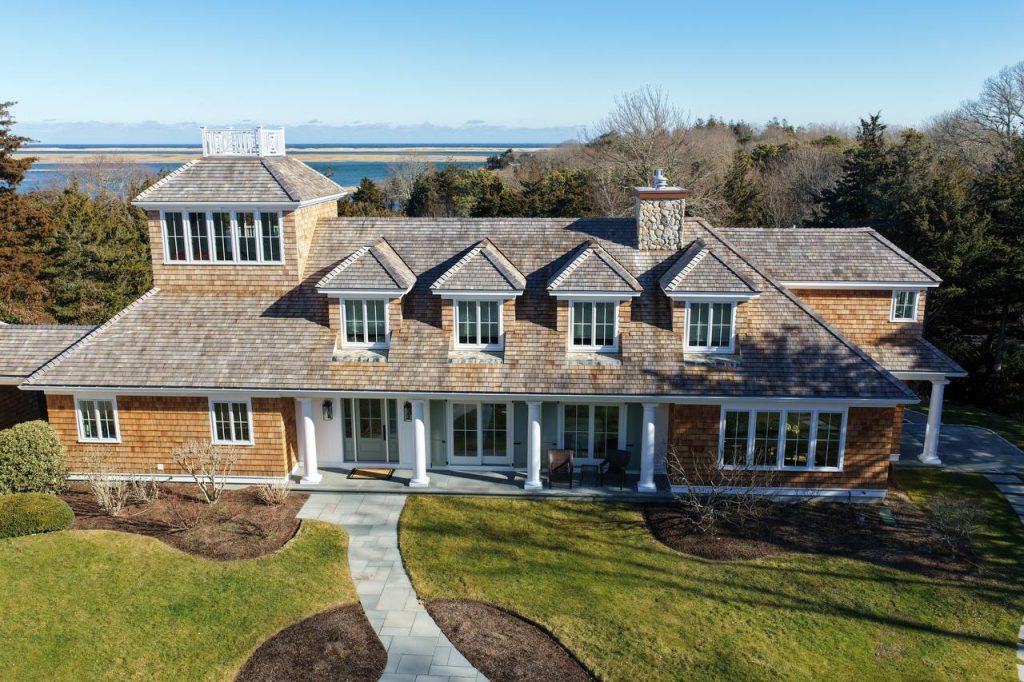
Critical detailing steps included:
- Maintaining a consistent 1/8” back-ventilation gap behind each shingle course
- Using 316-grade stainless steel ring-shank fasteners driven to precise depth to avoid fiber crushing
- Leaving bottom edges unsealed to permit natural moisture egress
- Isolating white architectural columns and trim from direct wood-to-wood contact using composite spacers to prevent moisture wicking
This protocol extends the repaint cycle from 5–7 years to 12–15 years while preventing trapped moisture degradation—a common failure point in coastal painted cladding.
Complex Roof Geometry & Precision Shingle Engineering
The residence features a multi-pitch roof system with intersecting valleys, multiple dormers, a stone chimney, and a prominent circular “crow’s nest” observation tower. Each plane introduces unique hydrodynamic and wind-uplift challenges that standard exposure calculations cannot address.
We adjusted shingle exposure rates based on slope pitch (steeper planes received slightly reduced exposure for tighter water shedding) and aligned joints perpendicular to prevailing wind vectors to minimize capillary wicking. On the crow’s nest’s curved profile, we employed a radial tapering technique: shingles were custom-cut and sequentially overlapped to maintain a continuous drainage plane without compromising the structural integrity of the underlying deck.
Flashing at the stone chimney transition utilized a stepped, counter-flashed copper system with slip joints to accommodate differential thermal movement between masonry and wood framing. All valleys were lined with high-temp self-adhering membrane, and ridge ventilation was calibrated to maintain balanced attic pressure, reducing moisture condensation during coastal temperature inversions. The result is a roof system that sheds water dynamically rather than relying on static sealing.
EPDM Integration & Flat-to-Pitched Transition Detailing
Modern coastal homes rarely feature monolithic roofs. The crow’s nest platform, balcony transitions, and architectural parapets required flat roofing solutions. We specified 60-mil reinforced EPDM for its proven elongation capacity (>400%), ozone resistance, and compatibility with complex penetrations.
The critical engineering challenge lies in the termination detail where EPDM meets pitched cedar shingles. Direct adhesion between the two systems is prohibited due to incompatible thermal expansion rates and moisture-trapping risks. Instead, we designed a multi-layer transition:
- A continuous stainless steel drip edge anchored to structural framing
- A reinforced peel-and-stick EPDM termination bar
- A polyurethane elastomeric sealant joint that remains flexible through seasonal movement
- Redundant sealing at all railing anchors and scuppers using custom neoprene boots
The membrane was installed with a minimum 1/4” per foot slope toward internal drains, and all seams were heat-welded rather than chemically adhered to ensure long-term bond integrity in high-UV environments. Pre-installation flood testing verified zero leakage at transition zones before terrace substrates were applied.
The 14-Day Execution Protocol: Logistics Under Coastal Constraints
Completing a full roof and facade replacement on a multi-level oceanfront home in two weeks is not a product of acceleration—it’s a product of precision planning. Coastal weather windows are narrow; sustained winds over 20 mph or relative humidity above 75% halt critical flashing, shingle, and paint steps.
We deployed a phased crew model:
- Day 1–3: Controlled demolition, substrate moisture testing, and structural repair routing
- Day 4–8: Roof installation progressing from lowest eave to highest ridge to maintain continuous underlayment coverage
- Day 6–11: Cladding teams working independently but coordinating daily with roofing supervisors to ensure trim alignment and ventilation continuity
- Day 10–14: EPDM integration, paint system application, and final QA verification
Daily quality checks included fastener pull-out verification, underlayment seam continuity audits, and substrate moisture readings before paint application. Pre-fabricated trim components and off-site shingle tapering reduced on-site cutting waste by ~40%, while redundant scaffolding and real-time weather tracking minimized downtime. The synchronized workflow delivered structural integrity without compromising installation standards.
Long-Term Performance & Coastal Maintenance Realities
Premium materials do not eliminate maintenance—they redefine its frequency and methodology. Painted white cedar requires bi-annual inspection of fastener heads, trim sealants, and drainage paths. Gentle low-pressure rinsing removes salt crystallization; abrasive cleaning or high-pressure washing compromises the paint matrix. Cedar roofing benefits from periodic debris clearance in valleys and around dormers to prevent moisture retention during storm events.
The painted system will gradually soften in tone but retains its protective barrier as long as the film remains intact. EPDM transitions should be inspected annually for sealant shrinkage or membrane puncture near penetrations. With proper stewardship, this integrated exterior system will reliably exceed 40–50 years of service in Cape Cod’s marine climate.
Final Notes for Coastal Renovation Professionals
Coastal exterior upgrades succeed when material science, geometric precision, and disciplined execution align. The Orleans project demonstrates how traditional cedar craftsmanship, when integrated with modern detailing protocols and weather-aware project management, creates a resilient architectural envelope. For builders, architects, and homeowners navigating similar coastal renovations, the difference between premature failure and generational performance lies in the details: ventilation continuity, thermal accommodation, and uncompromising transition detailing.