Python in Trading: How Developers Turn Code Into Real Market Profits
A decade ago, trading was dominated by large institutions with proprietary systems and expensive infrastructure. Today, a skilled developer with Python can compete in the same arena—sometimes even outperforming traditional players.
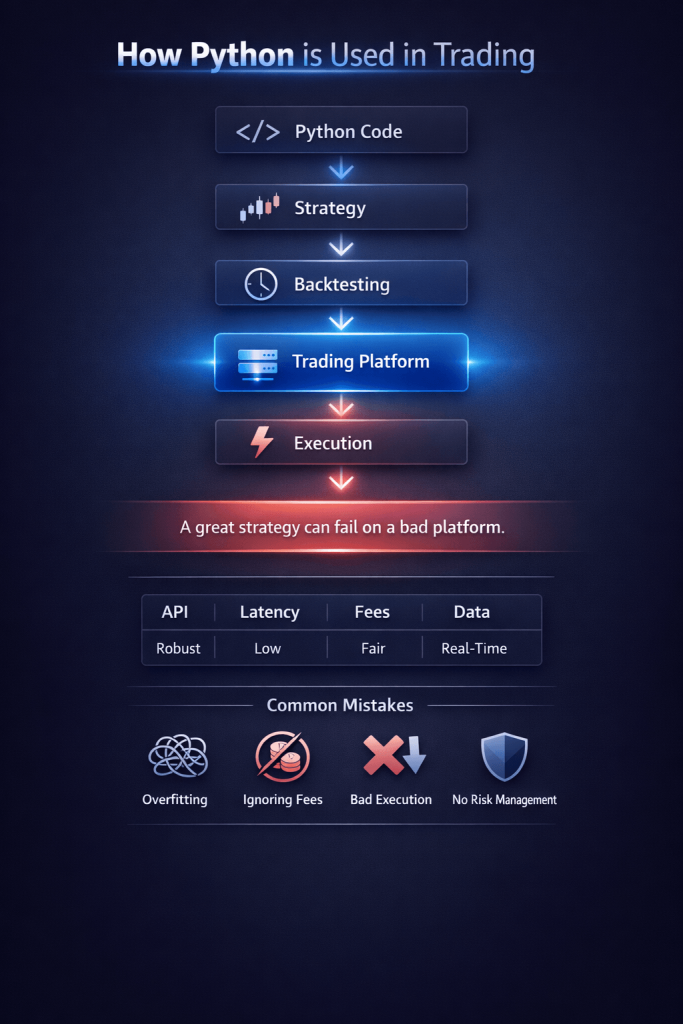
But here’s the reality most beginners don’t realize: writing a trading algorithm is only half the battle. The other half is execution—where your strategy meets the real market. That’s exactly why serious traders take time to compare trading platforms before deploying a single line of code into live conditions.
In this article, we’ll go far beyond the basics. You’ll learn how Python is actually used in trading environments, how developers build systems that survive real market conditions, and why your choice of platform can directly impact your profitability.
The Rise of Python in Financial Markets
Python didn’t become the dominant language in trading by accident. It solved a real problem: how to move from idea to execution quickly.
In markets, speed of iteration matters more than raw performance. You don’t need to process millions of transactions per second—you need to test, adapt, and refine strategies as market conditions evolve.
Why Python Works So Well
- Rapid prototyping — test strategies in hours instead of weeks
- Rich libraries — Pandas, NumPy, SciPy, TA-Lib
- API integration — connect directly to brokers and exchanges
- Data handling — perfect for financial time-series analysis
- Community support — massive ecosystem and documentation
From personal experience, the biggest advantage is not just flexibility—it’s adaptability. Markets shift constantly, and Python lets you pivot without rebuilding everything from scratch.
How Python is Used in Real Trading Systems
Let’s break down how Python fits into actual trading workflows—not theory, but real-world usage.
1. Market Data Collection
Everything starts with data. Without clean, reliable data, your strategy is meaningless.
- Pulling price data via APIs
- Streaming real-time quotes
- Collecting order book data
- Tracking macroeconomic indicators
Developers often underestimate how messy market data can be. Missing values, incorrect timestamps, and latency issues can distort your entire strategy.

2. Strategy Development
This is where ideas turn into code.
Common strategy types include:
- Trend-following systems
- Mean reversion models
- Breakout strategies
- Arbitrage setups
At this stage, Python allows you to experiment quickly. You’re not looking for perfection—you’re looking for an edge.
3. Backtesting
Backtesting separates serious traders from gamblers.
| Component | Role | Risk if Ignored |
|---|---|---|
| Historical Data | Simulates past performance | False expectations |
| Transaction Costs | Accounts for real fees | Overestimated profits |
| Slippage | Models execution delays | Unrealistic results |
| Position Sizing | Controls risk exposure | Account blow-up |
One of the biggest mistakes developers make is building “perfect” strategies that fail the moment they hit real market conditions.
4. Automation and Execution
Once a strategy is validated, automation comes into play.
- Execute trades instantly
- Monitor positions 24/7
- React to market changes without delay
- Remove emotional decision-making
This is where Python interacts directly with trading platforms—and where things often go wrong.
The Critical Role of Trading Platforms
Here’s a hard truth: your strategy might be profitable on paper but fail in reality due to poor execution.
That failure usually comes from the platform—not the code.
What Makes a Platform “Good” for Python Traders?
- Stable API — no unexpected disconnects
- Low latency — fast order execution
- Accurate data feeds — no price discrepancies
- Transparent fees — no hidden costs
- Security — protection against hacks and breaches
If your API fails during a volatile market move, your algorithm becomes useless—and potentially dangerous.
Comparing Trading Platforms: A Practical Framework
Instead of choosing a broker randomly, developers should evaluate platforms systematically.
| Factor | Why It Matters | Developer Perspective |
|---|---|---|
| API Quality | Core for automation | Check documentation and uptime |
| Execution Speed | Impacts slippage | Test with live orders |
| Fees | Affects net profit | Include in backtesting |
| Asset Coverage | Strategy flexibility | Forex, crypto, stocks |
| Regulation | Safety of funds | Avoid unverified brokers |
Professional traders don’t just pick platforms—they stress-test them.
Python + API: The Execution Layer
At the core of algorithmic trading is the interaction between Python and broker APIs.
Typical Execution Flow
- Fetch real-time market data
- Run strategy logic
- Generate trade signal
- Send order via API
- Confirm execution
- Track open positions
Every step introduces potential failure points.
For example:
- Delayed data → wrong signals
- API timeout → missed trades
- Execution lag → slippage
This is why experienced traders test their systems in live conditions before scaling.
Risk Management: The Real Edge
Most beginner traders focus on entry signals. Professionals focus on risk.
Python allows you to enforce discipline programmatically.
Core Risk Rules
- Risk 1–2% per trade
- Set stop-loss automatically
- Limit daily drawdown
- Diversify across assets
The beauty of automation is consistency. Unlike humans, code doesn’t panic.
Psychology Still Matters (Even With Code)
You might think automation eliminates emotions. It doesn’t—it shifts them.
The emotional decisions happen when:
- You modify your strategy after losses
- You over-optimize based on past data
- You increase risk after a winning streak
A disciplined trader treats their system like a business—not a gamble.
Common Mistakes Developers Make in Trading
- Overcomplicating strategies
- Ignoring transaction costs
- Using unrealistic backtests
- Choosing unreliable platforms
- Failing to monitor live systems
In trading, simplicity often outperforms complexity.
Real Insight: Where Profits Actually Come From
After years in the market, one pattern becomes clear: profitable trading is not about genius algorithms.
It’s about execution.
Your edge comes from:
- Consistent strategy
- Reliable infrastructure
- Fast execution
- Strict risk control
Python enables all of this—but it doesn’t guarantee it.
Conclusion: Code Alone Is Not Enough
Python has democratized trading. Today, anyone with programming skills can build and deploy strategies.
But the market doesn’t reward code—it rewards systems that work in real conditions.
If you want to succeed, you need to think beyond development.
- Understand how markets behave
- Choose the right trading platform
- Test your system under stress
- Control your risk at all times
Because in trading, the difference between profit and loss isn’t your idea.
It’s how well you execute it.